
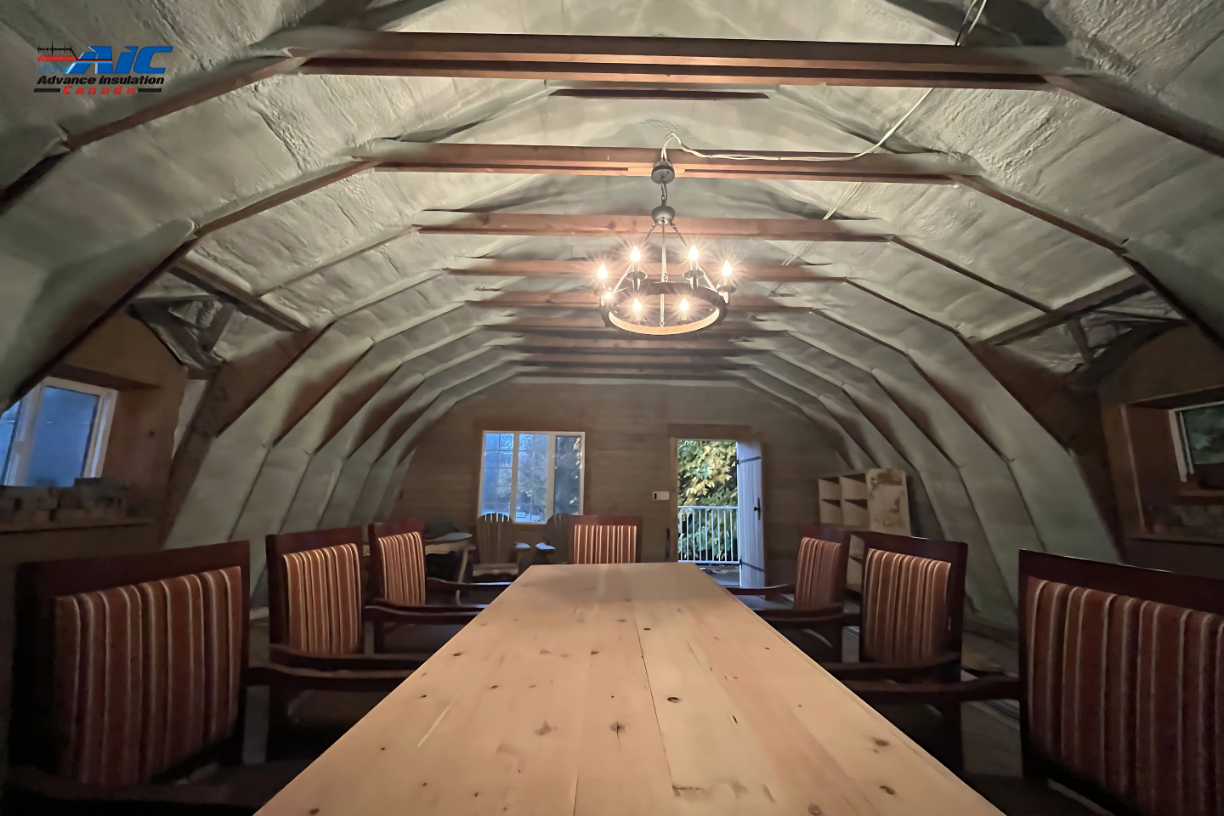
Summary: 2lb closed-cell spray foam offers a high R-6 to R-7 per inch rating, airtight sealing, and moisture resistance, making it a durable, space-saving insulation choice for homes and businesses. Advance Insulation Canada provides professional spray foam installation across British Columbia and Alberta for lasting energy savings.
Heating and cooling costs account for nearly 50% of total energy consumption in residential and commercial buildings. Poor insulation contributes significantly to energy waste, resulting in higher utility bills and reduced indoor comfort. To combat this, many property owners turn to 2lb closed-cell spray foam insulation, a high-performance solution known for its superior thermal resistance, moisture control, and structural reinforcement.
This type of spray foam insulation is widely used in homes, offices, warehouses, and industrial spaces due to its ability to seal gaps, reduce air leaks, and provide long-term energy efficiency. Unlike traditional insulation materials such as fiberglass batts or blown-in cellulose, closed cell spray foam creates an airtight, rigid barrier that enhances a building’s durability and energy efficiency.
In this article, we will discuss the benefits of 2lb closed-cell spray foam, its R-value, how it compares to other insulation types, and whether it can act as a vapor barrier. We will also highlight why Advance Insulation Canada is a trusted provider of spray foam insulation services in British Columbia and Alberta.
Best Spray Foam Insulation
2lb closed-cell spray foam insulation is considered one of the best spray foam options for homes and commercial buildings due to its high R-value, airtight sealing, and moisture resistance. The dense structure delivers superior thermal performance while also adding structural strength to walls and roofs.
Closed-cell foam resists sagging, settling, and moisture absorption, which helps maintain long-term energy efficiency. Property owners often choose it for attics, exterior walls, basements, and crawl spaces where maximum insulation performance matters. For long-term durability, energy savings, and indoor comfort, 2lb closed-cell spray foam stands out as a top insulation solution.
What Is Closed-Cell Spray Foam?
Closed-cell spray foam is a polyurethane-based insulation that expands upon application and hardens into a dense, rigid structure. It comprises tiny, tightly packed air pockets (closed cells), giving it superior resistance to heat transfer and moisture infiltration.
There are two main types of spray foam insulation:
- Open-Cell Spray Foam: Lower density, softer texture, and lower R-value. It allows air and moisture to pass through, making it less effective as a vapor barrier.
- Closed-Cell Spray Foam: Higher density, rigid structure, and higher R-value. It forms an airtight seal and serves as both an insulator and a moisture barrier.
More: Best Insulation Contractor for Rebate for Energy in Victoria, BC
Why 2lb Closed-Cell Spray Foam?
The 2lb specification refers to the foam’s density, meaning it weighs two pounds per cubic foot. This high density gives it better durability and stronger insulating power than open-cell foam. 2lb closed-cell spray foam is commonly used in:
- Exterior walls: Prevents heat loss and improves structural strength.
- Attics and roofs: Reduces heat gain and air leaks, lowering energy costs.
- Basements and crawl spaces : Protects against moisture and mold growth.
- Commercial and industrial buildings: Provides insulation and structural support in large spaces.
Unlike traditional insulation, 2lb closed-cell spray foam does not sag, shift, or deteriorate, ensuring long-term insulation performance.
What Is the R-Value of 2lb Closed-Cell Spray Foam Insulation?
The R-value of an insulation material determines its resistance to heat transfer. The higher the R-value, the better the insulation performance. 2lb closed-cell spray foam has an R-value of R-6 to R-7 per inch, making it one of the most efficient insulation materials available today.
This means that even a thin layer of 2lb closed-cell foam provides strong thermal resistance, making it an excellent choice for maximizing energy efficiency in compact spaces.
For example, to achieve an insulation level of R-21 (a common requirement for exterior walls), only about 3 to 3.5 inches of closed-cell foam is needed. In contrast, fiberglass batts would require nearly 6 inches. This space-saving advantage makes closed-cell foam a preferred option for walls, ceilings, and other areas where minimizing bulk is essential.
How Does the R-Value of 2lb Spray Foam Compare to Other Insulation Types?
| Insulation Type | R-Value per Inch |
|---|---|
| 2lb Closed-Cell Spray Foam | R-6 to R-7 |
| Fiberglass Batt | R-3 to R-4 |
| Blown-in Cellulose | R-3.2 to R-3.8 |
| Open-Cell Spray Foam | R-3.5 to R-4 |
2lb closed-cell spray foam offers nearly double the R-value per inch compared to fiberglass insulation, providing stronger thermal protection while requiring a thinner application. This makes it an ideal choice for spaces where maximizing insulation performance without adding bulk is essential.
Unlike cellulose insulation, which can settle or shift over time and lose effectiveness, closed-cell foam remains stable and retains its insulating properties for the long term. Additionally, while fiberglass batts often leave gaps around framing, allowing air leaks, spray foam forms a continuous, airtight seal, improving energy efficiency.
With its higher R-value and ability to prevent air leakage, 2lb closed-cell spray foam insulation helps significantly reduce heating and cooling costs over time, making it a smart investment for residential and commercial properties.
Can 2lb Spray Foam Insulation Be Used as a Vapor Barrier?
Yes, 2lb closed-cell spray foam functions as a vapor barrier when applied at 2 inches or more thickness. This means it prevents moisture from passing through walls, ceilings, and floors, which is a critical advantage in humid or damp environments.
Benefits of Using 2lb Closed-Cell Foam as a Vapor Barrier
- Prevents Moisture Buildup: Reduces the risk of mold, mildew, and wood rot.
- Enhances Indoor Air Quality: Blocks allergens and pollutants from entering the building.
- Increases Building Durability: Protects structures from water damage and insulation failure.
This makes closed-cell spray foam insulation ideal for basements, crawl spaces, and exterior walls in regions with high humidity or fluctuating temperatures.
Why Choose Advance Insulation Canada for Your Spray Foam Needs?
When investing in spray foam insulation, choosing the right insulation contractor is just as important as selecting the right material. Advance Insulation Canada is a trusted provider of spray foam insulation services in British Columbia and Alberta, known for its expertise and high-quality workmanship.
If you are looking for a reliable, long-term insulation solution, Advance Insulation Canada can help. Our team specializes in spray foam insulation installation, ensuring quality workmanship and energy savings for years to come.
Contact Advance Insulation Canada at 1-855-531-FOAM today for a free consultation and quote. Improve your home or business’s insulation and enjoy better energy efficiency and comfort all year round.
What to Expect When 2 lbs Spray Foam Insulation Is Installed
Before spraying starts, the crew clears the work area, masks windows, floors and mechanical equipment, and checks that the substrate is dry and free of loose debris. Foam will not bond properly to frost, dust or damp framing, so preparation takes real time in older Victoria, Duncan and Nanaimo homes. The material goes on in lifts, generally an inch or so at a pass, and each lift is allowed to set before the next one is applied. That controlled build is what keeps 2 pound closed cell spray foam insulation dense, stable and firmly adhered instead of curing unevenly in one thick coat.
Once the foam has cured, it is trimmed flush at studs and joists where drywall or sheathing follows, and the offcuts are bagged and removed. Ventilation runs during and after the application, and the space is left clear for a set period before other trades come back in.
Where Closed Cell Insulation Makes the Most Difference
Rim joists, crawl space walls, vaulted roof decks and shipping containers share the same problem: little room for thickness and a high risk of condensation. Closed cell insulation foam suits those areas because it air seals, insulates and resists moisture movement in a single application. In a Vancouver Island crawl space that usually means spraying the perimeter walls and rim joists rather than pushing batts between floor joists, where they sag and hold damp. In Alberta, the same approach is used on Quonset arches and sea cans, which have no framing cavities at all.
Closed cell insulating foam also stiffens steel panels and container walls, which is useful on shop buildings and site offices. Where wall depth or budget allows more thickness, open cell foam or blown-in fibre can be the better answer, and that comparison is part of the site visit before anything is specified.
Closed Cell Spray Foam R Value Per Inch and Why Thickness Is Specified
Two pound foam is sold and specified by installed depth, so the per inch figure on the manufacturer data sheet is the number that matters when a job is scoped. That figure is measured on cured, aged material, which is why installers build the foam up in passes and check depth with a gauge as they work. Under sprayed areas leave weak spots in the assembly, while over sprayed areas waste material and bulge past the framing line.
When a job is quoted, a target thickness is set for each assembly, because a rim joist, a crawl space wall and a roof deck all call for something different. Building officials often want the specified depth recorded, and the closed cell spray foam R value used in an energy model has to match what actually went on the surface.
2 Inches of Spray Foam R Value in a Wall or Crawl Space
Searches for 2 spray foam R value usually cover two separate questions: the density of the product, meaning 2lb foam, and the depth applied, meaning two inches. Both matter. Density governs the closed cell structure and how the foam handles moisture, while depth sets the thermal number for the assembly. Two inches on a rim joist behaves differently from two inches on a bare steel container in Fort McMurray, where the entire envelope depends on the foam.
On site the cavity is measured, the substrate is noted, and the depth is set to suit the assembly and the code path being followed. In retrofits on older homes in Victoria, Esquimalt and Courtenay, available depth is often the limiting factor, so the specification is built around what the existing framing allows.
Is closed cell spray foam a vapor barrier once it reaches full depth?
Cured 2lb foam controls vapour movement once it is thick enough, which is why a separate poly sheet is often left out of the assembly. In many crawl spaces and rim joist applications, 2″ closed cell foam is the target depth, but the requirement depends on the assembly and on the local building official. The needed depth is confirmed before spraying and the installed thickness is recorded.
Spray Closed Cell Foam Insulation for Sea Cans, Quonsets and Shop Buildings
Steel buildings have no cavities to fill and swing through wide temperature ranges, so spray closed cell foam insulation is applied directly to the inside face of the shell. The foam follows corrugations and ribs, seals the seams where warm indoor air would otherwise reach cold steel, and stays in place on curved Quonset arches. Containers used for storage, site offices or workshops in Fort McMurray, Edmonton and Calgary are handled the same way, with the ceiling, corners and door frames covered in continuous passes.
Work begins with a walkthrough to check for rust, standing moisture, and any wiring or plumbing that has to stay accessible. You get a free quote setting out the areas to be sprayed and the target depth, and we can point you toward BC and Alberta rebate programs where the upgrade qualifies.